
By Ayushie Shahane
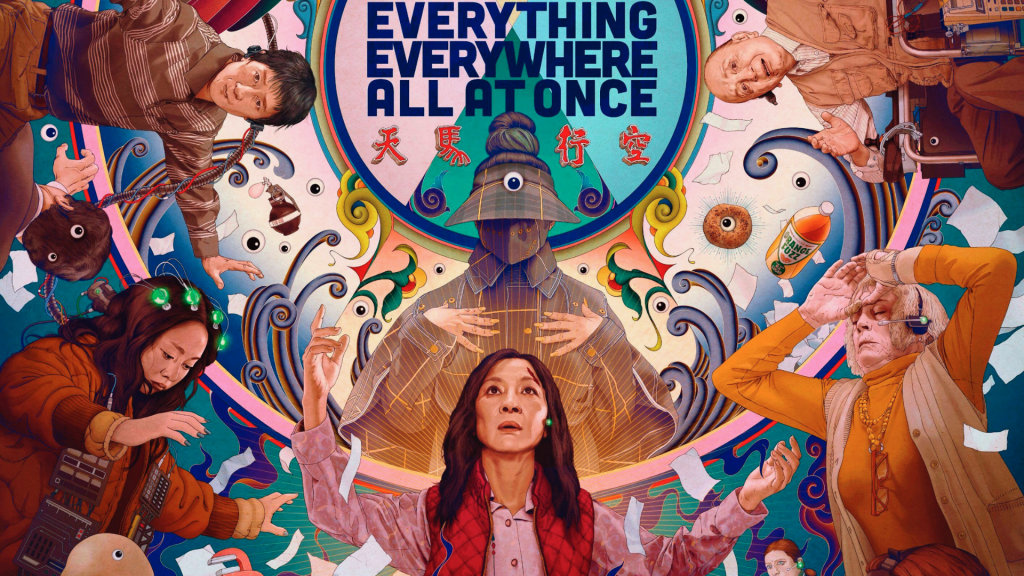
Image: EastMojo
Oscars 2023 had many memorable wins, whether it be RRR’s Naatu Naatu for Best Original Song, or The Elephant Whisperers for Best Documentary Short. However, the highlight of the event was, without a doubt, A24’s Everything Everywhere All At Once (EEAAO), which was nominated for eleven Oscars and took home seven. It was awarded Best Picture (Daniel Kwan, Daniel Scheinert, Jonathan Wang), Best Director (Daniel Kwan, Daniel Scheinert), Best Actress (Michelle Yeoh), Best Supporting Actor (Ke Huy Quan), Best Supporting Actress (Jamie Lee Curtis), Best Original Screenplay (Daniel Kwan and Daniel Scheinert), and Best Film Editing (Paul Rogers). But the film’s wins don’t stop there; EEAAO won the hearts of an entire generation of parents and children, especially those who are immigrants, who all found a bit of their own story scattered throughout the film.
Michelle Yeoh’s portrayal of Evelyn Quan Wang is the quintessential Asian mother: slightly overwhelmed, severely overworked, and somewhat overbearing. Her introduction takes place amidst a sea of paperwork, with her sitting in the middle, stuck and frustrated. She floats between modernity and a traditional Asian outlook; Evelyn accepts her queer daughter and her girlfriend, but doesn’t introduce them as such to her father. She worries about what her father will think of their unorthodox relationship, about his granddaughter’s sexuality, and instead introduces them as friends to avoid any risk of conflict. Evelyn works to maintain the peace in her family, which often results in the loss of her own peace. She sometimes lashes out to vent out her frustration, the brunt of which falls on Waymond, her husband, who patiently faces it all. As every Asian mother surely has, Evelyn looks back on life not with regret, but with a sad curiosity, of what could’ve been had she chosen a different path, had she chosen her dreams.
Evelyn is a force to be reckoned with, only matched by her daughter, Joy Wang. Joy feels like an amalgamation of every Asian kid, struggling to be her parent’s daughter, while still being her full self. The constant back and forth between her and Evelyn results in some wins and some losses; her sexuality is accepted, the tattoo on her arm is not. Joy rebels against her mother, as to be expected, but the film takes on her rebellion with more than just a touch of absurdism. Joy’s darkest emotions play out in vivid color on the big screen. She is her mother’s antithesis. Evelyn pushes against her struggles, fighting to climb out of her rabbit hole of problems; Joy feels the weight of struggle push her even further down, to a point of hopelessness and nihilism. Joy doesn’t quite hate her mother, no, she simply hates their relationship, much of which stems from a struggle which plagues nearly every parent-child relationship: an inability to see one’s parents as people.
Joy, like most kids, expects her mother to act perfectly in her best interests, and in her expectations of perfection, she puts her mother on a pedestal. She fails to recognize that her mother is also a person, one who can make mistakes and might not always know what to do. She criticizes her mother’s refusal to tell her grandfather about her girlfriend, without considering her mother’s own upbringing and relationship with her grandfather. Joy feels disconnected from her mother, and blames her for it. Even in her pursuit to connect with her mother, she speaks her mind without considering Evelyn’s perspective, not as a mother, but as a person who has lived a life just as full and difficult as she has, if not more.
Evelyn similarly struggles with understanding that Joy is an adult. Joy will always be Evelyn’s daughter, but Evelyn struggles to acknowledge Joy’s adulthood and, therefore, her autonomy. She wants Joy to listen to her, and to stop rebelling against her, without realizing that she is stifling her daughter as she herself was once stifled. She chooses what she thinks is best for her daughter and pushes her down that path, all while her daughter distances herself to try to get away from the pressure.
The pressure of being a parent and the pressure of being a child is what connected every single viewer to this film. Parents are put on a pedestal, from where they must seek out the best path for their child to lead a perfect life. Children are pressured to be the perfect child, to obey, and to follow the path laid out by their parents. Parents are solely seen as parents, and children as children. Both fail to see the other as a person, an individual capable of, and entitled to making mistakes, and to finding their own path in life. EEAAO heart-wrenchingly explores the complexities of parent-child relationships, generational trauma, and the unwritten rules of Asian households. The film stands by the claim that “nothing matters,” a phrase said by both mother and daughter in justification of their actions. However, the differing views on what comes next, on how one should react to the seeming insignificance of our existence, is what pulls the film together. Through the absurdism of different dimensions, universes, and even bodies, Evelyn and Joy learn about the very real truth of our world. After the climax, after all the action, a simple conversation between the two brings out the very real philosophy of this fantastical film, leaving the entire audience, myself included, in silent tears.
“Maybe it’s like you said. Maybe there is something out there, some new discovery, that will make us feel like even smaller pieces of shit. Something that explains why you still went looking for me, through all of this noise. And why, no matter what, I still want to be here with you. I will always, always, want to be here with you…”
“Do you still wanna do your party?”
“We can do whatever we want. Nothing matters.”
 Filmistaani
Leave a comment